
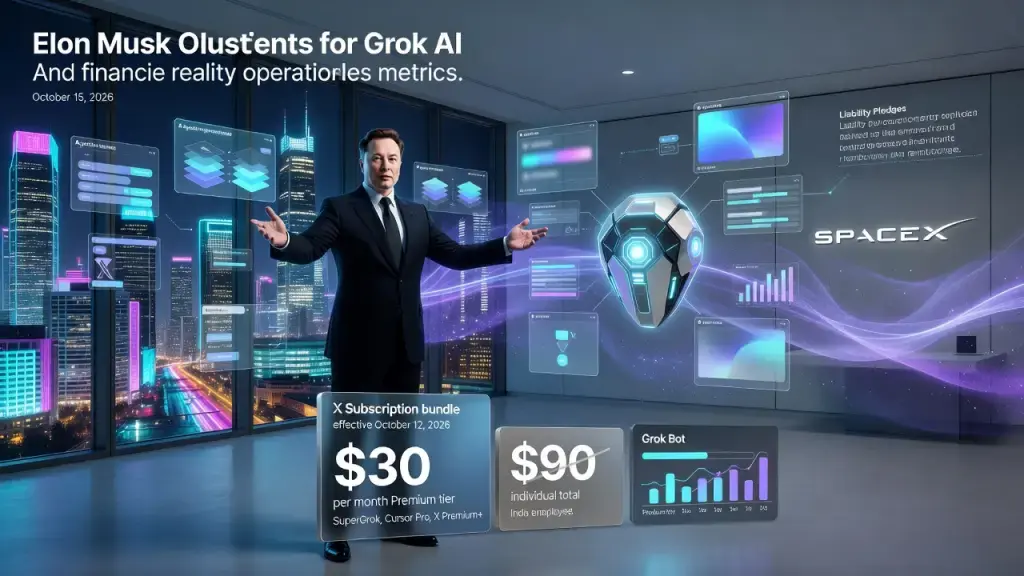
Elon Musk posted two words on a Saturday night - "This really works!" - and followed them with a claim that his company's chatbot "can pay for itself." That's a significant statement for a subscription product to carry. It raises a fair question: what does Grok actually do in late 2026 that would justify the comparison to a paid employee or a billable service?
What Grok Bot Actually Does
According to xAI, Grok Bot - launched in beta on August 11, 2026 - isn't a conversational assistant in the traditional sense. It's built to act: signing into existing tools, managing inboxes, completing multi-step tasks across applications, and pausing only when it needs a user's approval to proceed. The company describes it as an agentic layer sitting on top of the core Grok model, with persistent memory and a cloud-based environment that carries context between sessions rather than starting fresh each time.
That distinction - answering questions versus taking actions - is the entire basis for the "pays for itself" argument. If a tool is doing work a business would otherwise pay a person to do, or saving enough hours to offset its cost, the subscription fee becomes a rounding error. That's a real economic argument, not just marketing language. Whether it holds up depends entirely on how much of a given workflow the tool can actually touch without supervision.
The Bundle Math Behind the Pricing
Effective October 12, 2026, xAI restructured its offerings under what it calls "The X Subscription." The Premium tier, priced at $30 per month, bundles SuperGrok, Cursor Pro, and X Premium+ - three products xAI says previously cost $90 per month combined. Grok Bot access comes included at Premium and above, with its own separate usage allowance apart from standard Grok and Cursor limits.
For a user already paying for two of those three products individually, the bundle math is straightforward and favorable. For someone who only wants a chatbot, it's a different calculation - you're paying for a package, not a feature.
- Current model: Grok 4.7, released September 21, 2026, with text, voice, image, file, and live web handling
- Real-time integration with X gives it access to recent information that static, pre-trained models can't match
- Grok Bot usage is metered separately from the base chatbot and Cursor allowances
An Unusual Liability Commitment
Here's the part that stands out. According to reporting from October 15, 2026, Musk pledged that SpaceX would reimburse users for financial mistakes or leaked card information resulting from Grok's handling of purchases. Most major AI developers push transaction liability onto the user through standard terms of service - if the bot makes an error during checkout, that's the user's problem. A direct reimbursement pledge tied to a named company is a departure from that norm, and it signals xAI wants the "pay for itself" framing backed by actual accountability rather than a disclaimer buried in a terms page.
That said, a verbal pledge reported in the press and a binding contractual guarantee are not the same thing. Anyone relying on an AI agent for financial tasks should still read the actual terms of service rather than take a public statement as a substitute for one.
What This Means in Practice
Musk is both the promoter and the owner of this product, so the usual skepticism applies to superlatives like "this really works." That said, the structural claims - agentic task execution, persistent memory, bundled pricing that undercuts separate subscriptions - are documented by xAI itself and don't require taking Musk's word for it.
The honest framing is this: the capability is real, but "pays for itself" is an outcome, not a built-in guarantee. Users already paying for Cursor and X Premium+ get an easy case for the bundle before the productivity argument even factors in. Everyone else needs to ask a plainer question - not whether the AI is impressive, but whether it's doing enough unsupervised work to justify the line item.