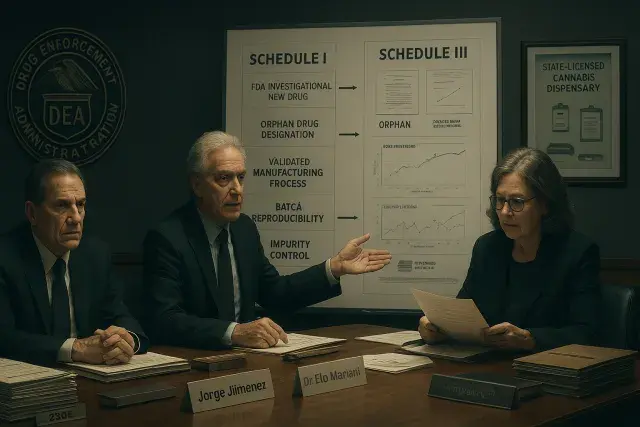
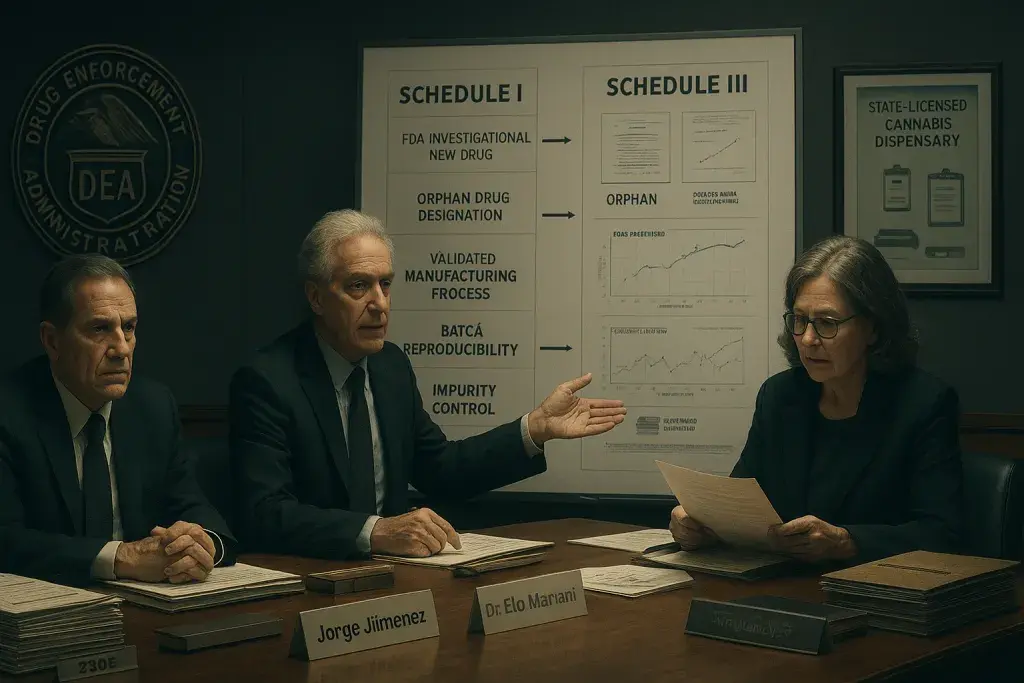
When the Drug Enforcement Administration convenes its marijuana rescheduling hearing on June 29, the most consequential voices in the room may not belong to industry advocates or policy reformers. A group of former federal enforcement officials and pharmaceutical scientists - people who spent careers building and applying the very regulatory architecture now under scrutiny - has emerged to challenge the procedural foundation of the rescheduling process itself. Their argument is not about whether cannabis has legitimate medical applications. It is about whether the federal government can selectively abandon the standards it required of applicants who played by the rules.
That distinction matters far beyond the DEA hearing room. Across the licensed cannabis industry - from vertically integrated multi-state operators to single-license dispensaries relying on the best cannabis pos systems maine has to offer for compliance tracking and inventory management - operators have built their businesses inside a patchwork of state-level regulations that has never been fully reconciled with federal controlled-substance law. Any federal rescheduling that legitimizes state-market products without applying uniform pharmaceutical standards creates regulatory asymmetry with real commercial consequences. It sets a precedent about what "compliance" means - and who it applies to.
At the center of the opposition filings is Jorge Jimenez, a retired DEA Supervisory Diversion Investigator who spent nearly two decades inside the agency and ultimately served as Section Chief of both the Regulatory Section and the Import/Export Section at DEA Headquarters. In that role, Jimenez oversaw the registration of bulk manufacturers, importers, exporters, and controlled-substance registrants across the United States. Few people carry that level of institutional knowledge into a regulatory proceeding like this one. His core concern, as reflected in the filings, is that the current rescheduling framework appears positioned to create a separate pathway for state marijuana operators - one that bypasses the registration and compliance requirements that federally compliant applicants, including MMJ International Holdings, were required to satisfy.
The Pharmaceutical Standard Is Not a Bureaucratic Technicality
MMJ International Holdings spent years doing what federal regulators said was required: obtaining FDA Investigational New Drug authorizations, securing Orphan Drug Designation, establishing a DEA-registered analytical laboratory, and completing pharmaceutical manufacturing activities consistent with controlled-substance pharmaceutical development. Dr. Elio Mariani, a pharmaceutical scientist with more than forty-five years of experience in drug development, FDA regulatory affairs, analytical chemistry, and pharmaceutical commercialization, is joining the opposition proceedings to explain why that process is not optional.
The distinction Dr. Mariani draws is scientific, not political. Drug products that enter regulated commerce are required to demonstrate reproducibility across batches, stability over time, impurity control, validated manufacturing processes, and clinical evidence of safety and efficacy. Those requirements exist because patients - including vulnerable ones - are exposed to the products. A COA attached to a commercial cannabis product sold through a state-licensed dispensary is not the functional equivalent of the pharmaceutical validation process. The testing is not the same. The manufacturing controls are not the same. The evidentiary standard is not the same. To conflate the two in federal policy, according to this line of argument, is to hollow out the pharmaceutical approval framework without formally repealing it.
Also participating in opposition filings is Dr. Bertha Madras, a Harvard Medical School professor recognized as one of the country's leading researchers on addiction, neurobiology, and drug policy. Dr. Madras has raised concerns about rescheduling marijuana without resolving significant public-health questions - particularly regarding effects on vulnerable populations. Her presence in these proceedings reinforces the point: the resistance here is not rooted in ideology. It is rooted in scientific and regulatory methodology.
What This Means for Operators and the Broader Industry
Here is the catch for cannabis businesses watching this process. If rescheduling proceeds in a way that grants effective federal legitimacy to state-market cannabis products without requiring pharmaceutical-grade standards, the short-term commercial upside seems obvious - access to banking, relief from 280E tax treatment, reduced operational friction. But the long-term regulatory picture gets more complicated. A rescheduling framework built on contested procedural foundations is a framework that can be challenged, reversed, or litigated. Operators who have made capital investments - in licensing, real estate, compliance infrastructure, retail technology - based on the expectation of federal reform bear real exposure if that reform proves legally fragile.
The 280E question alone illustrates how high the stakes are. Cannabis businesses currently operating under federal Schedule I classification cannot deduct ordinary business expenses under the Internal Revenue Code's 280E provision, a structural tax burden that squeezes margins at every level of the supply chain - from wholesale pricing to dispensary-level P&L. Rescheduling to Schedule III would, in principle, resolve that. But if rescheduling is challenged on the grounds that DEA bypassed its own procedural and scientific requirements, the resolution may be slower and less certain than the industry is pricing in.
What's striking here is the composition of the opposition. This is not an effort organized by incumbent pharmaceutical companies protecting market share. It is led by a retired DEA official who managed the registration system, a pharmaceutical scientist who has worked inside the FDA-regulated drug development process for decades, and a Harvard researcher whose work focuses on public health. Their institutional credibility is the argument. And their argument - that federal regulators cannot selectively waive the standards they historically enforced - is one that courts, not just DEA, may ultimately have to evaluate.
The Regulatory Asymmetry Problem Has No Easy Fix
The deeper tension this proceeding exposes has been present since the first state medical cannabis programs launched: a bifurcated system in which state-licensed operators function under one set of rules and federally compliant pharmaceutical developers function under another. That bifurcation was tolerable - barely - as long as federal law remained formally unchanged. Rescheduling forces the question into the open. Either the federal government harmonizes standards upward, requiring state-market products to eventually meet pharmaceutical benchmarks, or it effectively endorses a separate regulatory tier for cannabis that does not apply to any other controlled-substance medicine.
Neither outcome is politically simple. The first path would impose compliance costs on state operators that many could not absorb. The second path does what Jimenez and his co-filers argue is already happening - creates a procedural double standard that undermines the integrity of the controlled-substance registration framework. To put it plainly: the June 29 hearing is not just about marijuana's scheduling status. It is about whether federal regulatory standards mean the same thing for everyone. For investors, compliance professionals, licensed operators, and policy observers, the answer to that question carries implications that extend well past cannabis.