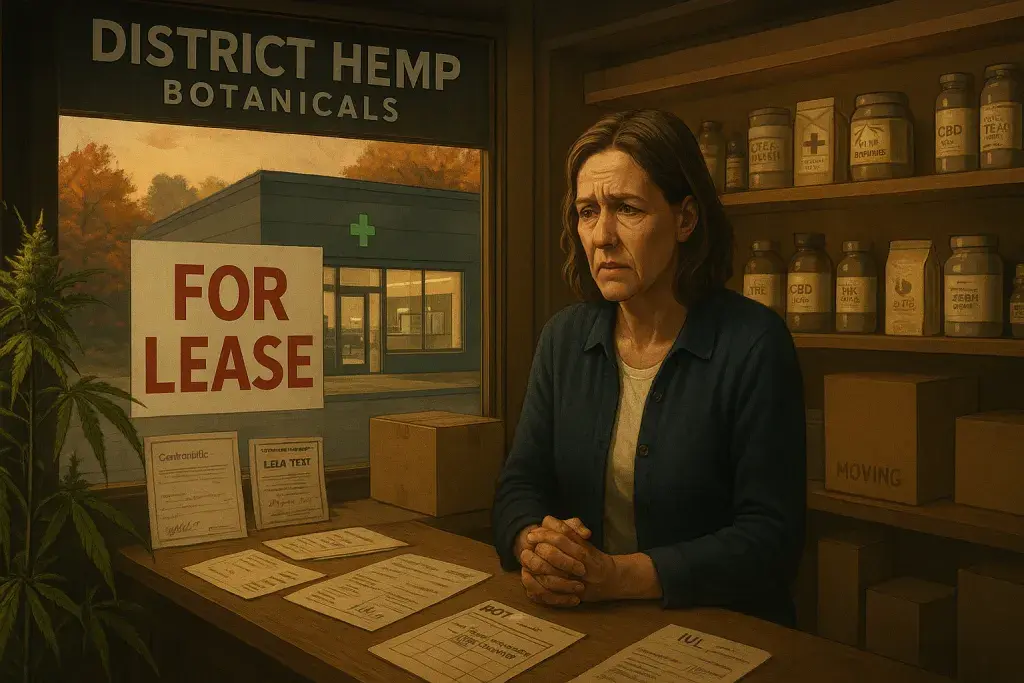
Barbara Biddle has already told her landlord she's leaving. The Manassas-based owner of District Hemp Botanicals is shutting down her Leesburg location - not because business has failed, but because the legal ground beneath it keeps shifting. With federal hemp definition changes set to take effect in November and Virginia's regulated adult-use cannabis market not expected to open until next July, small hemp operators like Biddle are caught in a gap that may not let them survive long enough to see the other side.
The timing couldn't be harder to manage. Hemp retailers have built their businesses around a product category - CBD- and THC-infused creams, drinks, gummies, bath salts - that Congress enabled through the 2018 Farm Bill, which permitted hemp-derived products containing up to 0.3 percent THC. That window is closing. Congressional action late last year reversed much of that framework, and by November, a broad swath of currently legal hemp products will be reclassified as controlled substances. Operators watching their inventory in states where dispensary infrastructure, like this dispensary POS, already supports compliant adult-use retail may find the contrast particularly sharp - hemp shops have no equivalent licensing pathway or regulatory home to step into, at least not yet.
Virginia's situation adds its own layer. The state has spent years building toward a recreational cannabis market, having first authorized a prescription-based medical cannabis program in 2018. The final state budget now includes a framework for legal adult-use sales, targeted for next July. But that timeline offers no bridge to hemp businesses currently operating under Virginia's existing hemp regulations - and those regulations were themselves tightened significantly in 2023.
A Stricter State Regime That Didn't Save the Industry
Senate Bill 903, passed in 2023, made Virginia's hemp rules more stringent than federal standards. Compliant operators had to meet child-resistant packaging requirements, submit to third-party lab testing, produce certificates of analysis, and reformulate products to meet a 25-to-1 CBD-to-THC ratio - meaning 25 parts cannabidiol for every one part THC. For small retailers and farmers, that meant real capital outlays: new packaging lines, lab fees, reformulation costs, updated labeling. Biddle and Caroline County hemp farmer Graham Redfern both point out that they made those investments in good faith.
That history makes the current moment particularly sharp. Having already absorbed the cost of compliance, these operators are now being told the rules are changing again - and the new rules effectively eliminate the product category they built around. Redfern, whose crops are already in the ground, put it plainly this spring: once hemp reaches maturity, it produces cannabinoids. That biological fact means industrial hemp farming, by its nature, will now fall outside the bounds of what federal law permits. "It's about impossible to create any industry in the industrial hemp world without taking the plant to maturity," he said.
Sen. Lashrecse Aird, D-Henrico, a sponsor of Virginia's cannabis legalization effort, has framed the 25-to-1 ratio as a loophole that allowed intoxicating products to be sold outside a regulated consumer-protection framework - not as a ban on hemp itself. She notes that Virginia's 2-milligram THC limit for hemp products remains intact. But for retailers whose product lines depend on the ratios that SB 903 explicitly authorized, that distinction may feel academic.
The Structural Problem: No Bridge Period, No Licensing Pathway
Here's the catch. Virginia's forthcoming adult-use market is a licensed, regulated system. That means dispensary licenses, compliance requirements, seed-to-sale tracking, and a full suite of retail obligations that take time and capital to meet - assuming licenses are available to independent operators at all. Hemp retailers don't automatically convert into licensed cannabis sellers. There is no established equivalency or streamlined onboarding mechanism currently on the books to get them there.
Redfern has been explicit about what that means in practice: "We are left with zero pathway and will not survive until July 2027 without a grace period." That's not a rhetorical point. It's an inventory, cash-flow, and lease-obligation problem. A farmer with crops in the ground and a retailer with a lease and a landlord can't simply pause operations and wait 12 months for a new licensing regime to materialize.
The concern about market consolidation runs beneath all of this. Virginia's medical cannabis market has been operational for years, with established multi-state operators and vertically integrated license holders already positioned in the state. Redfern has suggested that the policy trajectory favors those incumbents over independent small businesses and local farmers - a tension that has appeared in cannabis regulatory debates across multiple states as adult-use markets open. Whether or not that characterization is accurate, the structural outcome is real: operators without existing cannabis licenses or access to capital for a licensing process have no clear route forward.
What Operators and Suppliers Should Watch
For the broader cannabis retail and B2B supply community, Virginia's situation is a working example of what happens when three timelines - federal hemp reclassification, state cannabis legalization, and existing small-business operating cycles - fail to sync. The gaps aren't just inconvenient. They destroy businesses.
Several pressure points are worth tracking closely:
- Federal hemp reclassification takes effect in November, ahead of Virginia's July adult-use launch - leaving a minimum eight-month window where many hemp products are illegal and licensed cannabis retail doesn't yet exist.
- Virginia's regulatory framework for adult-use will determine whether social equity provisions or small-business set-asides create any realistic on-ramp for independent operators currently in the hemp space.
- A grace period or transitional licensing mechanism - which Redfern and others have raised with lawmakers and the governor - would be the most direct policy fix, but nothing of that kind appears to have been formalized as of the time this was reported.
- State budget negotiations between the legislature and the governor have been consuming political bandwidth ahead of the July 1 deadline, which may have slowed movement on hemp-specific relief measures.
Biddle is scaling back, not closing entirely. One store stays open. But the decision to give notice on the Leesburg location - a business built on years of regulatory compliance, lab testing, and reformulation - is a concrete data point about what happens to small hemp retailers when the policy floor drops out. The market will see more of these decisions before Virginia's adult-use framework is operational. The question is whether the state builds any structure to catch operators who fall in between.