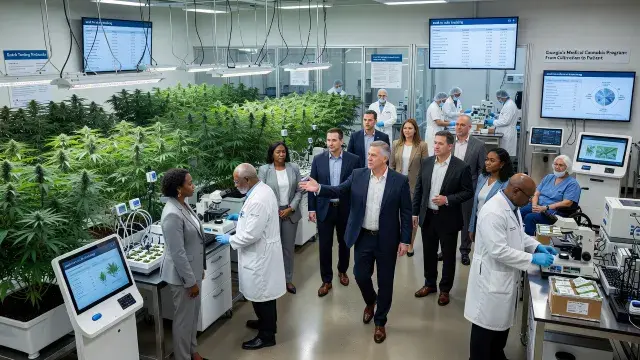
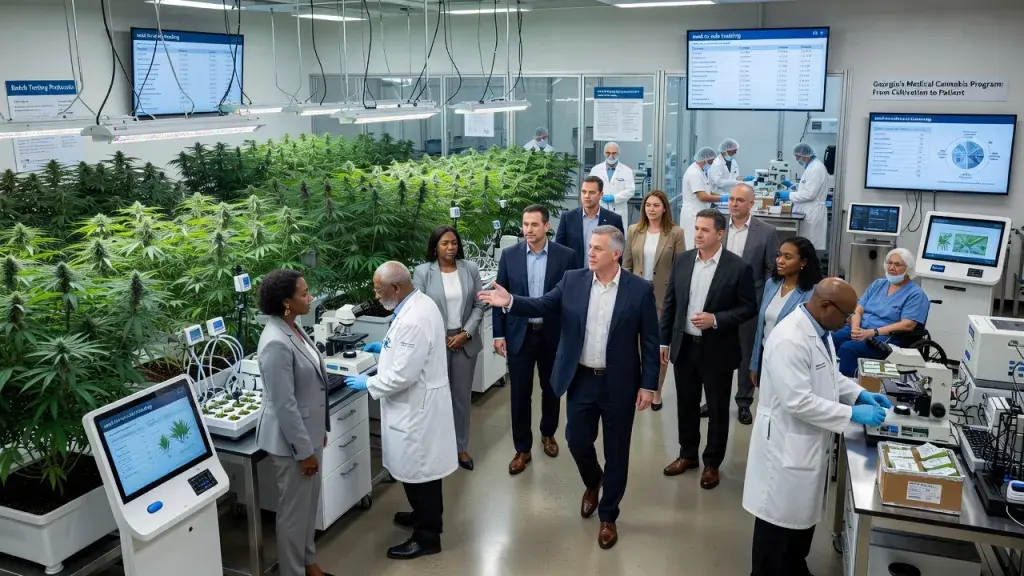
MACON-BIBB, Ga. - A decade after Georgia legalized medical cannabis, the program remains narrow, tightly capped, and politically fragile. That tension played out this week in Macon, where one of the state's three licensed medical cannabis producers invited lawmakers, doctors, and patients into its cultivation and manufacturing facility to make a case that has repeatedly failed on the floor of the General Assembly.
Judson Hill, market president of Georgia Fine Fettle, framed the tour as an education exercise rather than a lobbying event, though the two are hard to separate in a state where medical cannabis access still runs through a limited number of vertically integrated operators. Fine Fettle grows, manufactures, and distributes its own products to dispensaries, a structure that gives regulators tight control over the supply chain but leaves little room for the kind of competitive wholesale market that operators in more mature states have built. Operators managing that chain closely often look at how retail infrastructure functions elsewhere; comparing notes with markets that run some of the best cannabis pos systems virginia dispensaries use for compliance tracking and inventory reporting shows how far Georgia's program still has to go on the retail side. best cannabis pos systems virginia
Why the Legislature Keeps Stalling
Senate Bill 220 and House Bill 227 both aimed to expand the medical cannabis program this session - easing the process for patients to obtain a medical cannabis card and updating allowable product forms so patients could access more effective formulations. Both bills stalled in their respective chambers. That's not unusual for Georgia's cannabis legislation, which has a long record of dying in committee or losing momentum before a floor vote, even as the underlying program has been law for ten years.
State Representative Anissa Jones, who joined the tour, said seeing the cultivation and manufacturing process firsthand changed how she understood the program's controls. Her point is worth sitting with: much of the public skepticism around medical cannabis assumes a loosely regulated grow operation, when in practice licensed producers in Georgia operate under seed-to-sale tracking, batch testing, and compliance logging that would look familiar to anyone who has worked inside a regulated pharmaceutical supply chain.
The Access Gap Behind the Numbers
Dr. Elmore Alexander's comments cut to the operational core of the debate. He estimated that the current product lineup addresses roughly 80% of patients adequately, but the remaining 20% - a smaller population with more complex needs - simply can't be served without additional product forms and broader program access. That gap matters for operators too. A restricted product form list limits SKU diversity on dispensary menus, caps wholesale flexibility, and keeps the entire program smaller than it would be under a more permissive framework.
For licensed operators, the calculus is straightforward: a tightly capped, three-operator market means limited competitive pressure but also limited volume. Expanding patient access and card eligibility, as SB 220 and HB 227 proposed, would grow the addressable market without changing the underlying compliance structure - lab testing, compliant packaging, and distribution controls would remain in place regardless of how many patients qualify.
What Comes Next
- Legislative sessions in Georgia have repeatedly produced cannabis bills that pass one chamber but stall in the other.
- Facility tours involving lawmakers, doctors, and patients are becoming a recurring strategy for operators trying to build legislative support ahead of future sessions.
- Any future expansion would need to address both patient card access and the range of approved product forms to close the gap Dr. Alexander described.
Until lawmakers move, Georgia's medical cannabis program stays where it has been for years: legal, controlled, and smaller than the patient population it was built to serve.