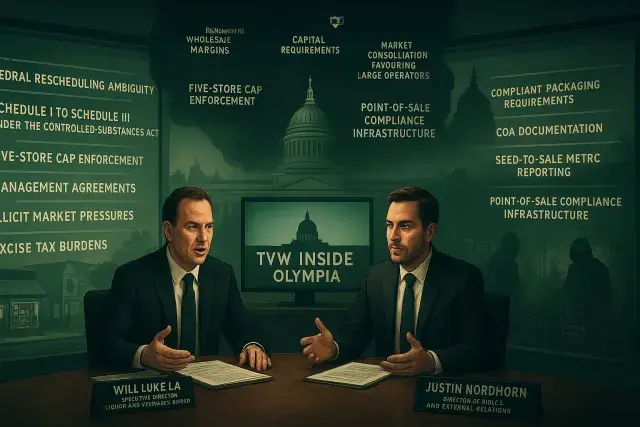
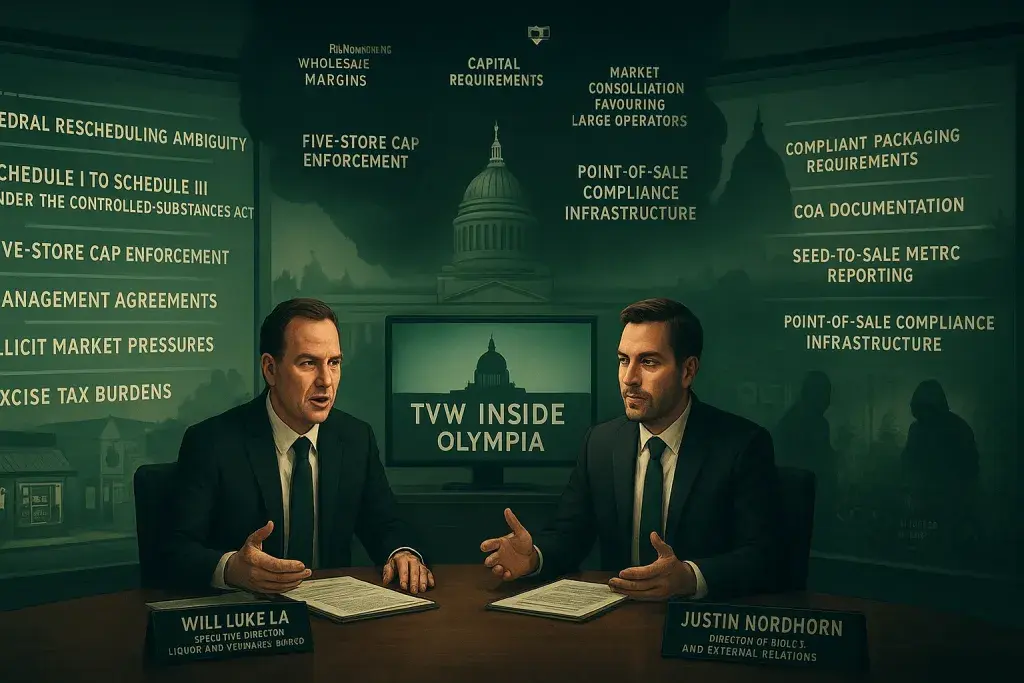
Washington State's legal cannabis market is operating under a thickening cloud of uncertainty - federal rescheduling ambiguity, accelerating market consolidation, and an illicit market that licensed operators simply cannot outrun. Speaking on TVW's "Inside Olympia," Washington State Liquor and Cannabis Board Executive Director Will Lukela and Director of Policy and External Relations Justin Nordhorn laid out the pressure points facing the state's regulated industry in frank terms. The message for licensed retailers, wholesalers, and brands: the ground beneath the market is still shifting.
Federal Rescheduling Leaves State Regulators Without a Playbook
The federal rescheduling question - moving cannabis from Schedule I to Schedule III under the Controlled Substances Act - sounds like progress on paper. In practice, though, the downstream implications for state-regulated markets are anything but settled. Lukela acknowledged as much directly: "We're still searching for what it means." That's not a throwaway line. State regulators in Washington are dealing with a cannabis framework where medical and adult-use markets are substantially integrated, which means any federal policy shift could create compliance friction at multiple points simultaneously. Operators in other regulated states know this dynamic well - operators researching tools like cannabis pos software maryland and similar state-specific compliance infrastructure are already thinking about how point-of-sale systems, seed-to-sale tracking, and reporting requirements might need to adapt if federal rescheduling triggers new tax treatment, banking rules, or labeling mandates. The uncertainty isn't abstract; it lands on compliance logs, inventory management workflows, and wholesale pricing structures.
The Five-Store Cap and the Fight to Preserve a Small-Business Model
Washington built its adult-use market on a deliberately small-business-oriented licensing framework, including a cap limiting individual ownership to five retail locations. The concern at the LCB isn't that the cap on paper has changed - it hasn't - but that management agreements were emerging as a mechanism to let larger operators extend effective influence over additional retail locations without technically exceeding ownership limits. A new state law has moved to close that gap by restricting those arrangements. What's striking here is how familiar this problem is across regulated cannabis markets: the structural pressure toward consolidation is real, driven by the cost of compliance infrastructure, shrinking wholesale margins, and the capital requirements of running a multi-SKU retail operation at scale. Large operators have clear advantages in absorbing those costs. Small independent licensees generally don't. Washington's regulators are explicitly trying to hold that line.
Illicit Market Enforcement Remains the Industry's Unresolved Problem
Nordhorn and Lukela identified illicit-market enforcement as one of the most persistent challenges facing the licensed industry - and it's the one where regulators have the least leverage. The math is straightforward and frustrating: unlicensed operators carry none of the cost burden that licensed dispensaries do. No excise tax. No compliant packaging requirements. No COA documentation, no seed-to-sale METRC reporting, no age verification protocols. That cost asymmetry translates directly into retail price gaps that licensed stores cannot fully close regardless of how well they manage budroom inventory or negotiate wholesale menus. Enforcement against illicit operators typically falls across multiple agencies - state regulators, local law enforcement, county prosecutors - and coordinating those efforts is slow work. For licensed retailers, the operational implication is that competing on price alone is a losing position. The compliance infrastructure that weighs on licensed operators - lab-tested products, traceable supply chains, responsible retailing practices - is also the clearest point of differentiation they hold over unlicensed alternatives.
What This Means for Operators Watching From Other States
Washington is one of the most mature adult-use markets in the country, which makes the LCB's candor worth paying attention to. The challenges Lukela and Nordhorn described - regulatory uncertainty from federal action, consolidation pressure on small licensees, illicit-market competition - aren't Washington-specific problems. They map directly onto conditions in nearly every regulated state market. Operators in newer adult-use markets are building compliance infrastructure and ownership structures right now, often without full visibility into how federal rescheduling, state cap enforcement, or illicit-market suppression will play out over the next several years. The takeaway from Washington's experience is practical: build compliance systems that can adapt, structure ownership and management agreements with clear legal review, and don't assume the regulatory framework will stay static. The LCB is still figuring it out. So is everyone else.