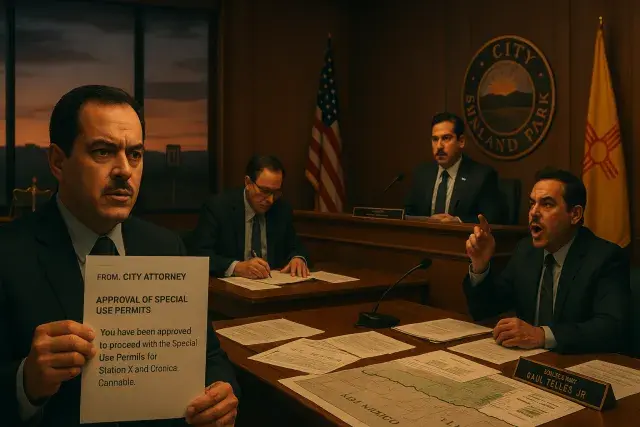
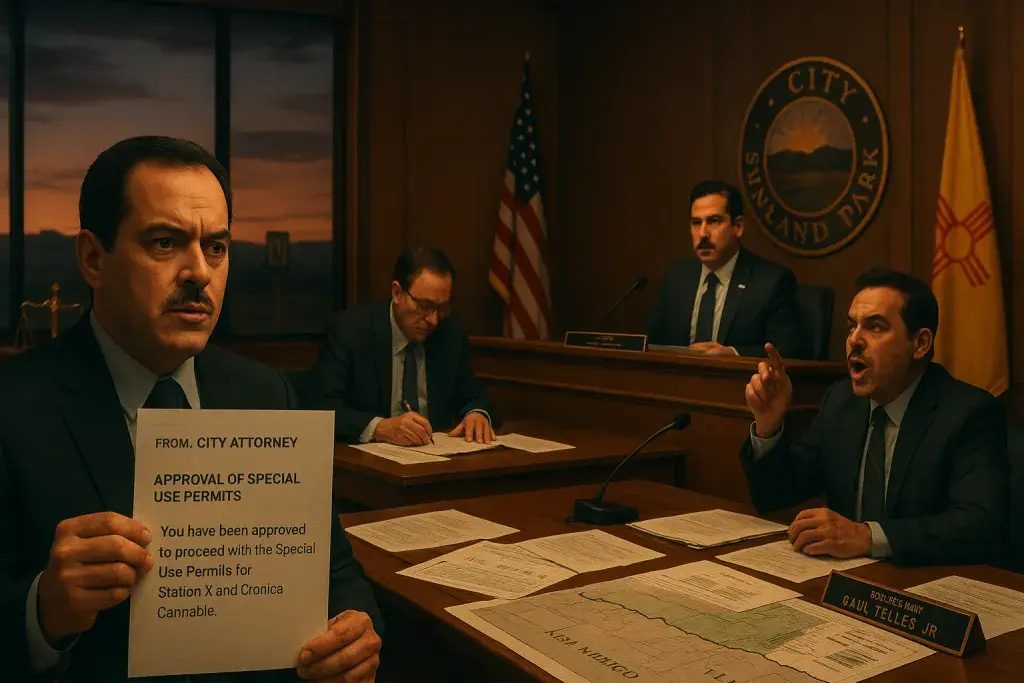
A procedural dispute at a New Mexico border city's council meeting has left two licensed cannabis businesses in legal limbo - and raised sharper questions about how local governments handle zoning approvals for cannabis operators seeking to open near state lines. Station X and Cronica Cannabis, both owned by Chadcor Holding NM, LLC, entered May 19's Sunland Park City Council meeting expecting a clerical correction. They left without one, and their attorney left with a litigation roadmap instead.
What the Council Actually Voted On - and Why It Matters
The underlying issue is a Special Use Permit, or SUP - the local land-use authorization that sits between a state-issued cannabis license and an operational dispensary. In New Mexico, as in most adult-use states, holding a state cannabis license does not automatically grant the right to open at a specific location. Municipal zoning approvals, conditional use permits, and SUPs operate as a separate layer of licensing authority. An operator can be fully compliant with the Cannabis Regulation Act at the state level and still be blocked at the city or county level through zoning.
At the previous meeting, Mayor Javier Perrea announced the council's vote fell short of the threshold needed to approve the two permits. That announcement was apparently incorrect. City Attorney Spencer Edelman sent a written communication to Raul Carrillo, the businesses' attorney, stating that the council had in fact approved the SUPs and that a correction would be entered at the May 19 meeting. That is a meaningful document - a city attorney's written confirmation of a vote outcome carries real weight in any subsequent legal proceeding. Then the May 19 meeting arrived, the ratification vote failed, and the correction didn't happen.
Here's the catch: Councilman Raul Telles Jr. framed the ratification vote as simply restating what the council had already decided the week before - not as an opportunity to reverse it. If the prior vote did in fact constitute approval, then the failure to ratify doesn't nullify what was already on the record. That distinction is precisely the kind of procedural ambiguity that ends up in front of a judge.
The Legal Record That Carrillo Is Walking Into Court With
For cannabis operators, written communications from city legal counsel are not background noise. They are evidence. Carrillo walked into the May 19 meeting holding an email from the city's own attorney confirming the approval. That's not a rumor or an interpretation - it's a dated communication from the official whose job is to advise the council on exactly these matters.
Chadcor's statement made clear the company intends to return to the Third Judicial District Court and seek relief, noting the court has already ruled in its favor on a related matter. The company framed its position plainly: it wants the rules on the books in New Mexico applied consistently, without exception. That is a measured but direct statement from an operator that has already been through this process and knows the procedural terrain.
What's striking here is the operational reality sitting underneath the legal dispute. Every week that Station X and Cronica Cannabis cannot open is a week of lost revenue, continuing overhead, and compounding startup costs - lease payments, staffing commitments, licensed inventory that may need to be held or transferred, and working capital that isn't turning. For a cannabis business operating under New Mexico's regulatory framework, that kind of delay doesn't pause the financial clock.
A Familiar Pattern for Cannabis Operators Near State Lines
Businesses sited near state lines, as these two appear to be, face an additional layer of scrutiny. Proximity to another state - in this case, Texas, where cannabis remains broadly illegal - often intensifies local political opposition and complicates permit approvals. Local officials in border communities can face constituent pressure that has less to do with zoning criteria and more to do with the symbolic politics of cannabis proximity to a neighboring jurisdiction with no legal adult-use market.
That context doesn't change the legal standard for approving or denying an SUP, but it does explain why procedural irregularities are more likely to surface in these settings. When a governing body is conflicted about an outcome, the process around the vote tends to get sloppy. Minutes get unclear. Threshold calculations get disputed. Attorneys get contradictory signals. All of that eventually becomes the record in a judicial review proceeding.
New Mexico has been one of the more actively expanding adult-use markets since legalization, with the Cannabis Control Division overseeing a licensing structure that includes producer, retailer, and microbusiness licenses, among others. State-level approvals, in other words, are real - and operators who have cleared that process carry a legitimate expectation that local permitting will follow established criteria rather than informal political temperature readings.
What Operators in Similar Positions Should Watch
The Sunland Park situation is instructive beyond its specific facts. A few things stand out for any cannabis operator dealing with local permitting:
- Document every communication from local government, including informal emails, and preserve metadata showing when they were sent and received.
- Understand the vote threshold requirements for SUP approval in the relevant jurisdiction before the meeting - not after.
- If a city attorney's communication contradicts what a mayor announced from the dais, treat that discrepancy as a potential legal asset, not a clerical problem to wait out.
- Know whether your jurisdiction has been litigated before on cannabis permitting. Courts that have already weighed in on an issue once tend to provide faster resolution on the same legal ground the second time.
Chadcor's statement that it anticipates a favorable outcome is consistent with the posture of an operator that has already cleared judicial review once and holds written confirmation of council approval from the city's own attorney. Whether the Third Judicial District Court agrees will ultimately depend on how the vote record is interpreted - but the company is not walking in empty-handed. For Station X and Cronica Cannabis, the path to opening still runs through the courthouse before it runs through the dispensary door.