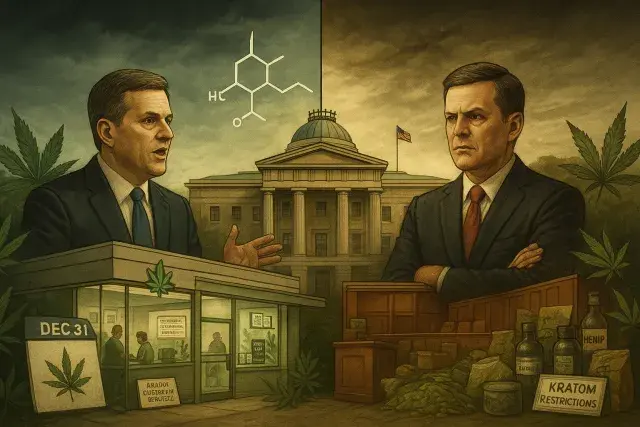
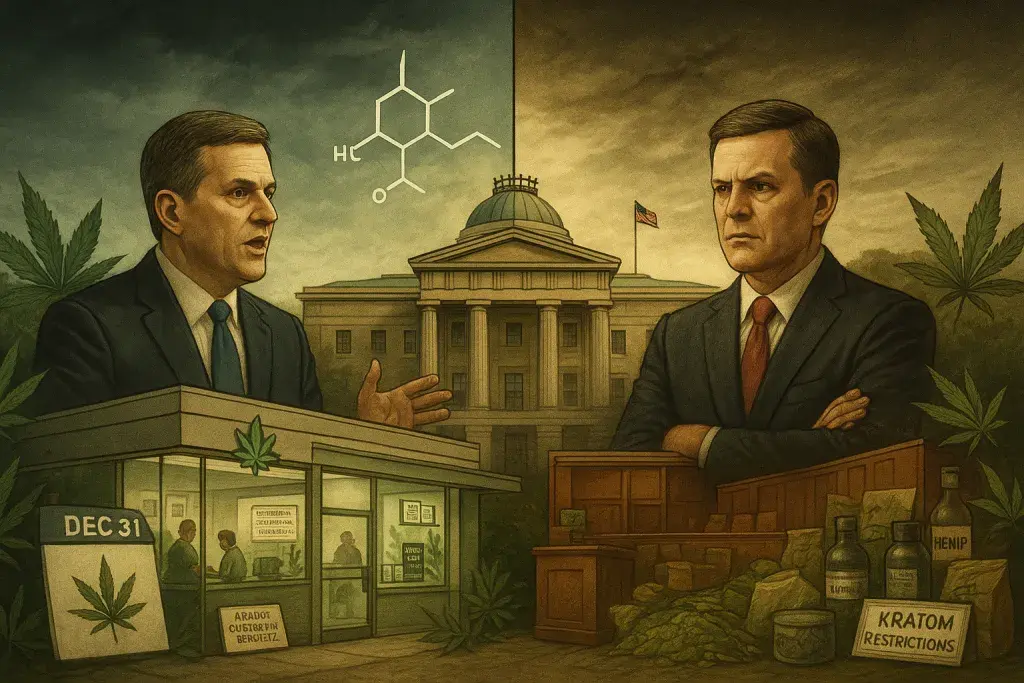
North Carolina has no legal adult-use marijuana market, no functioning medical cannabis program, and a hemp market that operates largely without the kind of consumer-safety guardrails that licensed dispensary operators in regulated states take as baseline requirements. That gap is now the center of a visible policy confrontation between Gov. Josh Stein, a Democrat who supports full cannabis legalization, and House Speaker Destin Hall, a Republican whose caucus has stated, flatly, that it has "no interest in doing any sort of marijuana, medicinal or otherwise." For cannabis businesses watching from adjacent states - and for any operator or investor with an eye on the Southeast - the standoff tells a clear story about how long a market can stay frozen even as the products themselves flow freely.
The regulatory vacuum is not theoretical. A commission Stein empaneled last year released an interim report in April recommending that North Carolina abandon the legal distinction between hemp and marijuana and instead regulate THC as a molecule - a framework that several legal-market states have found more durable as cultivators push plant genetics toward higher potency. As Stein put it in a recent interview with local outlet The Assembly, "cannabis is cannabis." The commission's report flags what any compliance professional already knows: where THC products are available but unregulated, there are no required age verification protocols, no mandatory lab testing, no certificate of analysis requirements, and no compliant packaging standards. States that have built working adult-use frameworks - from Colorado to Illinois to Massachusetts, where the infrastructure includes everything from track-and-trace integration to dispensary pos system Massachusetts deployments built around state compliance requirements - arrived at those systems precisely because unregulated access created identifiable risks that lawmakers ultimately couldn't ignore. North Carolina's commission is making the same argument, just a decade later.
Here's the catch, though. A commission report and a governor's public support do not move a bill through a House caucus that has made its position explicit. Speaker Hall told reporters his members are reviewing a separate Senate-passed bill focused on restricting hemp and kratom products - a narrower measure concerned with keeping certain products away from consumers under 21 and removing what lawmakers consider bad actors from the market. That is meaningfully different from the comprehensive THC-regulation framework Stein's commission is recommending. Whether Stein would sign a hemp-restriction bill that doesn't address the broader marijuana question remains an open question, and the politics around it are not clean. The governor acknowledged that shifting Republican opinion won't be fast, pointing instead to how North Carolina's attitudes toward alcohol sales evolved over decades - Sunday sales, wine in supermarkets, mixed drinks across counties - as evidence that regulatory positions do move, eventually.
The Medical Cannabis Divide Isn't Going Away
North Carolina's Senate has passed medical cannabis legislation multiple times. The House has refused to act on it - and the reasoning from House members is candid: some believe a medical program functions as a ramp toward adult-use legalization, and their constituents, they say, don't want that. That's a different objection than arguing the policy is wrong on the merits. It's a strategic block. Rep. Jeffrey McNeely put it plainly to The Assembly: the fear isn't the medical program itself, it's what comes after.
What's striking here is that this calculation may be shifting at the federal level in ways that give some Republican legislators new political cover. North Carolina's Senate President Pro Tem Phil Berger has said the chamber will take a more serious look at medical marijuana following the Trump administration's move to reschedule cannabis federally. Rescheduling doesn't legalize cannabis at the federal level, but it does change the political optics - and for operators and investors assessing when North Carolina might become a licensed market, that signal matters more than another failed floor vote.
What a Regulated Market Would Actually Require
If North Carolina does move toward any form of licensed cannabis retail - medical or adult-use - the operational build-out would be substantial. States that have launched regulated markets typically require seed-to-sale tracking integrated with a state system like METRC, point-of-sale compliance tied to real-time inventory reporting, age verification protocols at the point of sale, lab testing with certificates of analysis before any product reaches a retail shelf, and excise tax collection structures that layer onto already-complex retail accounting. For a state that currently has no marijuana licensing infrastructure at all, standing that up takes time - usually measured in years from legislative passage to first retail transaction.
The Eastern Band of Cherokee Indians opened what is effectively North Carolina's first marijuana dispensary in 2024, operating under tribal sovereignty rather than state law. That operation exists as a kind of proof of concept on the state's own soil - but it doesn't create a regulatory model that Raleigh can simply adopt. A state-licensed market would require the General Assembly to authorize a licensing body, define license categories, set testing requirements, establish tax collection mechanisms, and address the social equity provisions that Stein's prior task force - convened during his time as attorney general - recommended after examining racially disparate enforcement patterns. None of that is simple. None of it is fast.
The Business Case for Watching This Closely
North Carolina is a large state. A licensed cannabis market there would represent a meaningful commercial opportunity for multi-state operators, brands seeking wholesale distribution, technology vendors, compliance consultants, and real estate investors who understand what licensed retail buildout requires. The commission's final report is due by December 31 of this year, which sets a policy conversation deadline - not a legislative one, but an important marker nonetheless.
Democratic lawmakers have also filed legislation that would let voters decide the question at the ballot box, though Berger has said it's unlikely to advance. Separately, bipartisan movement on psychedelics reform has begun in the legislature - which, taken together, suggests that the state's political conversation about controlled substances is broader and more active than the House Speaker's single-line dismissal implies. In practice, though, "active conversation" and "enacted policy" are separated by exactly the kind of chamber divide North Carolina currently has. Operators and investors should be tracking this, not banking on it - not yet.