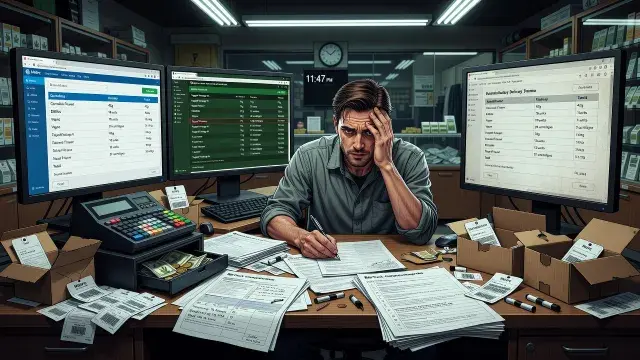
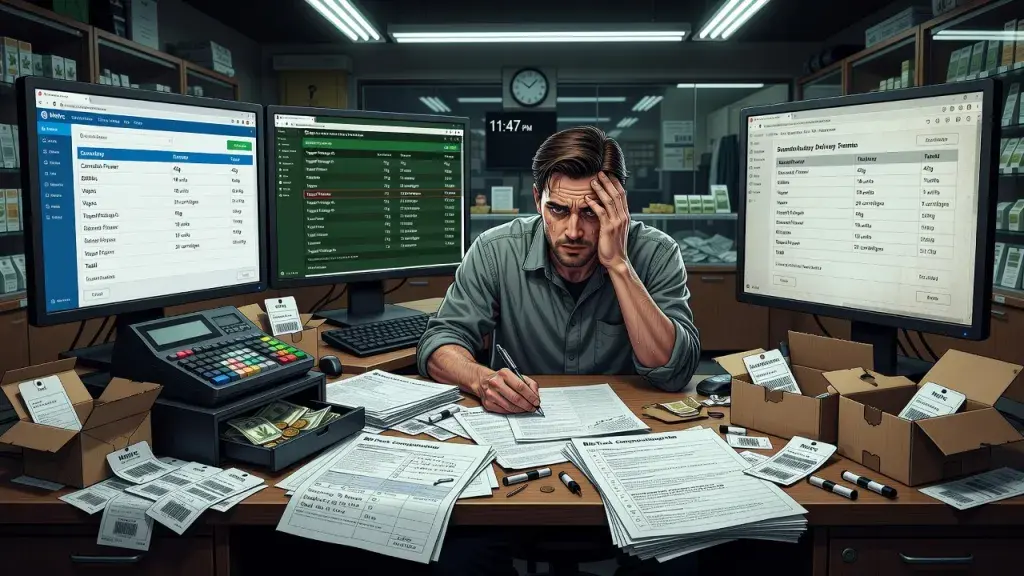
Three systems, three different inventory counts, one closing shift that won't end on time. It's a familiar scene in dispensary back offices: the point-of-sale says one number, the state's track-and-trace platform says another, and the distributor's delivery paperwork tells a third story entirely. The instinct is to blame the software. The real issue usually sits one layer deeper, in how - or whether - those systems talk to each other.
Why Inventory Discrepancies Are a Structural Problem, Not a Glitch
Cannabis retail runs on a compliance architecture that general retail never had to build. Every unit sold has to trace back to a tagged package in the state's track-and-trace system, whether that's Metrc or BioTrack. When a POS doesn't push updates in real time, gaps open up between what's physically on the shelf and what the state believes is on the shelf. A small variance might look like a rounding error. In practice, regulators treat inventory shrinkage as a compliance signal, and some states trigger a mandatory review once the gap crosses a set threshold. That's not a hypothetical for operators - it's a standing operational risk built into how track-and-sale reporting works.
The deeper cause is usually architectural. A dispensary POS, a distributor's delivery system, and a state compliance database are three separate systems of record. If they're not integrated, someone on staff becomes the integration layer - manually re-keying receiving data, manually reconciling counts, manually accepting Metrc manifests. That's slow, and it's exactly where human error creeps into compliance recordkeeping.
What a Cannabis POS Has to Do That General Retail Software Doesn't
A cannabis point-of-sale system carries a compliance burden no Shopify or Square terminal was built for. Beyond checkout and payment processing, it has to verify purchase limits, confirm customer age and eligibility, tie every SKU to a tagged package, and report every transaction to the state in a format regulators can audit. Three requirements separate a workable cannabis POS from a liability:
- Direct, real-time integration with the state's track-and-trace system - not a batch upload that runs once a day
- Live inventory sync between the register and back-office counts, since delayed updates are exactly where discrepancies compound
- Connectivity to the rest of the technology stack - accounting software, e-commerce menus, loyalty platforms, and for vertically integrated operators, an ERP managing procurement and wholesale distribution
That third requirement is where a lot of operators get stuck. A POS can be excellent at retail and still leave a dispensary blind upstream.
POS and ERP Are Not the Same Layer
A point-of-sale system manages the consumer-facing transaction: checkout, register-level inventory, retail compliance reporting. An ERP manages what happens before that transaction ever occurs - procurement, manufacturing runs, wholesale distribution, cost accounting, and the Metrc transfers that move product between a cultivator, a processor, and a retail floor. For a single-location dispensary buying from outside distributors, a strong POS with compliance integration may be enough. For a vertically integrated operator running cultivation, manufacturing, and retail under one license structure, the ERP is where the actual operation lives, and a POS without a connection back to that system creates a silo. Wholesale teams can't see retail demand. Cost accounting doesn't reflect what's actually moving. Incoming transfers require manual entry instead of automatic reconciliation.
What Operators Should Weigh Before Choosing a System
Cannabis retail technology is a crowded field, and no single platform is right for every operator. A single-location independent has different priorities than a multi-state operator standardizing across a dozen stores. Questions worth asking before signing a contract include whether the vendor has a validated integration with the specific state compliance platform in use, whether inventory updates happen in real time or in batches, what the payment processing options look like given ongoing banking restrictions in cannabis, and whether the platform can connect to an ERP if the business later expands into cultivation or wholesale. None of this replaces sound internal controls - regular physical counts, trained budtenders, documented receiving procedures - but the right stack removes the manual reconciliation that eats staff time and introduces risk. The goal isn't a flashier terminal. It's a set of systems that agree with each other, so the end-of-day count means what it says.